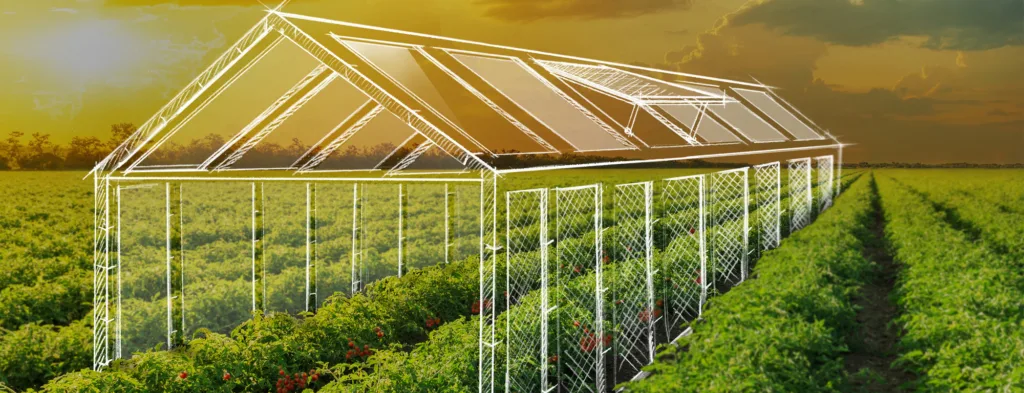
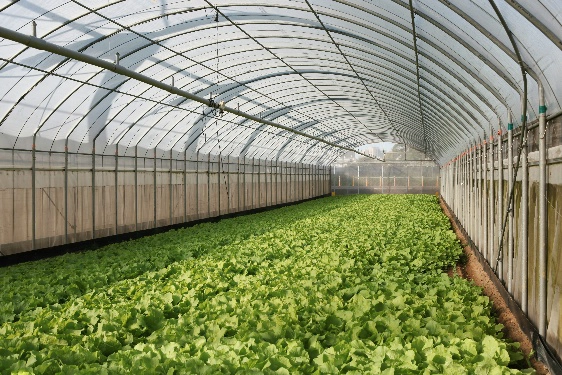
Good reasons to use ETFE instead of glass for your greenhouse
Modern greenhouse constructions face numerous challenges. It must ensure maximum and consistent light transmission, provide high energy efficiency, guarantee economic viability and durability, and remain flexible and scalable in its design. ETFE-Film can meet all these requirements, whereas glass solutions reach constructive and economic limits with these demands.
The following sections elaborate on these points.
Light transmission and plant growth
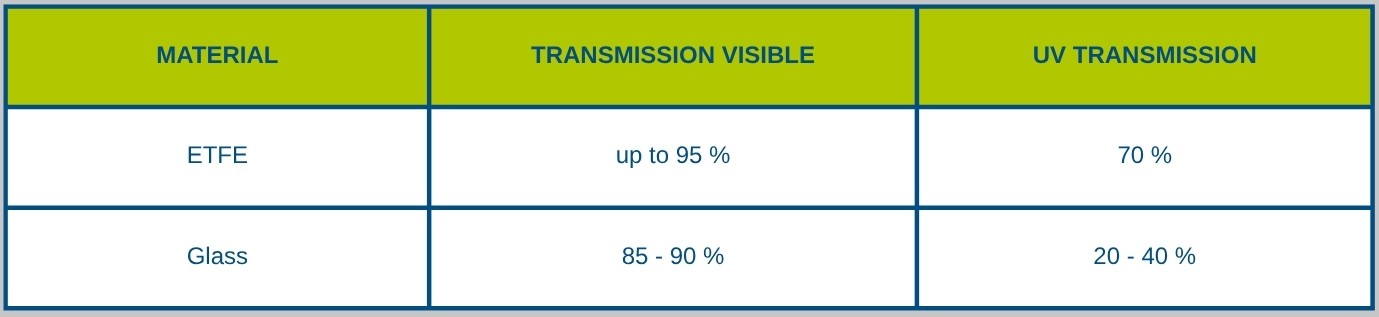
Both glass and ETFE film offer very high light transmission. Glass achieves transmission rates of up to 90%, while ETFE reaches up to 95%.
However, this is not the only important factor for plant growth. ETFE film is significantly more permeable in the UV range than glass, which positively influences the growth of many plant species. Glass, on the other hand, reflects and absorbs a large portion of the light.
Additionally, through printing or using multiple layers of the film, light transmission can be specifically diffused, which is only possible to a limited extent with glass. This property ensures an even distribution of light inside the greenhouse and reduces so-called “stress zones” for plants.
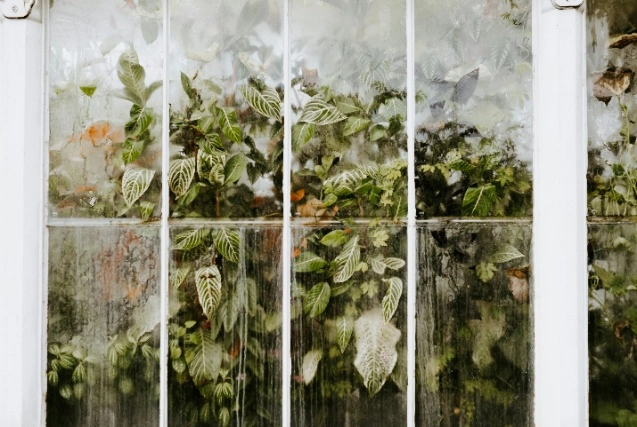
Thanks to a special coating, the film offers an anti-drop effect inside the greenhouse. This means that condensation runs off to the sides and does not drip uncontrollably onto the plants, unlike glass solutions.
Weight and construction
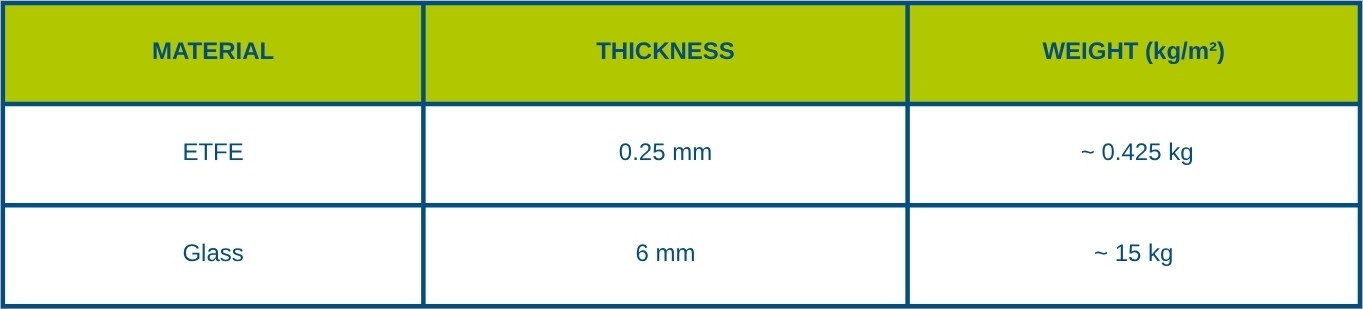
ETFE film is very lightweight and weighs about 1% of the weight of glass.
As a result, significantly fewer steel or aluminium structures are required, since the low weight allows larger spans without additional supports. Reducing the number of supporting structures naturally means a reduction in costs.
Glass, on the other hand, requires massive supporting structures, which significantly increases material usage, costs and construction time.
Cost Efficiency
With ETFE film, both investment and operating costs can be reduced.
ETFE constructions are usually less expensive overall thanks to lighter substructures and lower installation costs.
Operating costs are reduced by lower energy needs, minimal cleaning and maintenance from the film’s self-cleaning surface, and fewer repairs due to its robustness.
ETFE is extremely tear-resistant and offers an elongation at break of up to 450%! In the event of damage, ETFE film does not shatter, but tears in a controlled manner, which is significantly safer for staff, plants and equipment. Glass, especially during hail or storms, poses a safety risk due to glass splinters.
Thanks to the anti-adhesive surface of ETFE film, dust and dirt hardly adhere. By contrast, glass must be cleaned regularly to remove deposits, as they would otherwise reduce light transmission, which can impact the yield.
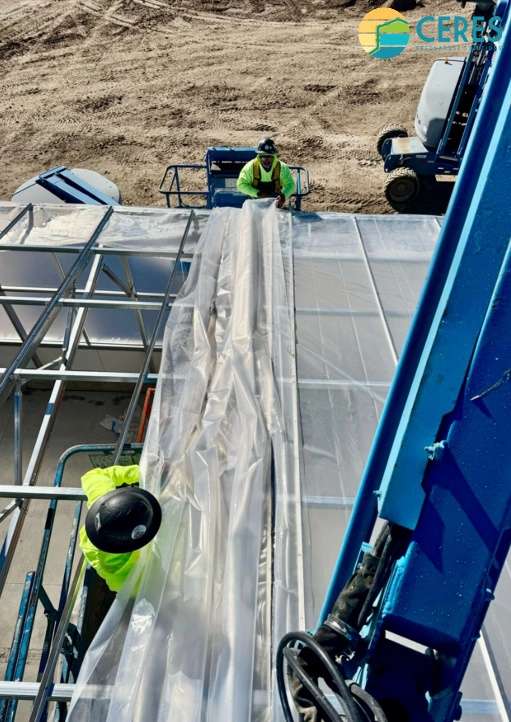
© Greenhouse by CERES Greenhouse Solutions
Energy Efficiency
ETFE film can be used as a multi-layered system. This solution provides very good thermal insulation properties due to the air layers trapped between the sheets, reducing heating costs in winter and lowering cooling requirements in summer. Single or even double glazing only achieve these insulation values with a significantly greater structural effort.
Sustainability
Glass enjoys a far better reputation than plastics when it comes to sustainability. However, when considering the bigger picture, both materials can be regarded as equally sustainable.
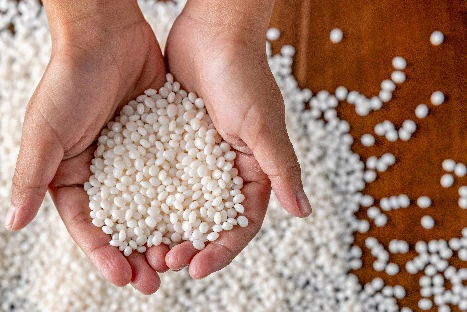
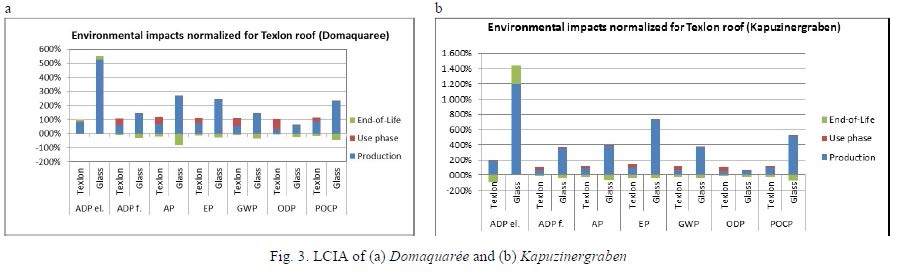
ETFE is 100% recyclable, CO₂ and transport emissions are greatly reduced thanks to the film’s light weight and improved energy efficiency permanently lowers the CO₂ footprint of greenhouse operation. Additionally, the long lifespan of ETFE reduces material consumption, further saving emissions. A study by Carl Maywald and Florence Riesser demonstrates that ETFE scores better than glass in almost all environmental indicators.
The only negative factor is its potential for ozone depletion, which can be significantly improved through modern manufacturing processes and the use of renewable energy.
Conclusion
In virtually all strategically important aspects of modern greenhouse construction, ETFE film is superior to glass. It offers better light yield and control, lower construction costs, higher energy efficiency, reduced lifecycle costs, a better environmental balance, greater safety and robustness and greater design and functional flexibility.
For operators, investors and planners seeking to realise greenhouse projects economically, securely and sustainably, ETFE is no longer simply an alternative, but the new standard.
Speak to our team about your optimal greenhouse solution:
Discover more blog posts

Interview with Andreas Freutsmiedl
Comparison of Greenhouse Films: ETFE vs. PE Film
Good reasons to use ETFE instead of glass for your greenhouse
High-Performance films at NOWOFOL